Vegetable import market in GCC countries
The Gulf Cooperation Council countries have emerged as one of the world’s most significant import markets for fresh vegetables. Due to harsh climatic conditions, water scarcity, and limited agricultural land, the region depends heavily on imported produce to meet daily consumption needs. Rising population levels, rapid urbanization, and a strong expatriate presence further intensify demand for fresh vegetables across the GCC. For exporters from agricultural economies such as India, the GCC offers a stable, high-volume, and long-term market opportunity.
With advanced port infrastructure, strong purchasing power, and government-backed food security initiatives, GCC countries have built highly efficient import ecosystems. However, success in this market requires a deep understanding of country-wise demand patterns, quality standards, logistics requirements, and compliance procedures. This guide provides a detailed overview of the vegetable import market across all six GCC countries and highlights how exporters can tap into these opportunities with the support of logistics partners like GlobalShipify.
Why GCC Countries Depend Heavily on Vegetable Imports

GCC countries dependence on vegetable imports
Vegetable imports are essential for GCC countries due to their arid climate and limited access to freshwater resources. Agricultural production is restricted to a few seasonal crops, making year-round self-sufficiency nearly impossible. Rapid urban expansion and a growing middle-class population have increased demand for fresh, diverse, and high-quality vegetables. Additionally, stringent food safety and quality standards have encouraged GCC importers to rely on established international suppliers who can deliver consistency and compliance.
As a result, an estimated seventy to ninety percent of vegetables consumed in the GCC are imported, creating sustained demand for exporters who can meet volume, freshness, and regulatory expectations.
United Arab Emirates: The Largest Vegetable Import and Re-Export Hub

UAE vegetable import and re-export hub
The United Arab Emirates is the largest vegetable importer in the GCC and serves as the primary gateway for regional trade. Its advanced port infrastructure, free trade zones, and efficient customs procedures make it a preferred destination for global exporters. Beyond domestic consumption, the UAE plays a critical role as a re-export hub, supplying vegetables to neighboring GCC countries and parts of Africa.
Vegetables such as onions, potatoes, tomatoes, green chilies, okra, and leafy greens are imported in large volumes to support supermarkets, hotels, restaurants, and catering services. For exporters, the UAE offers faster clearance processes, strong demand for premium and organic produce, and an excellent entry point into the wider Middle East market.
Saudi Arabia: A High-Volume and Consumption-Driven Market
Saudi Arabia vegetable import market
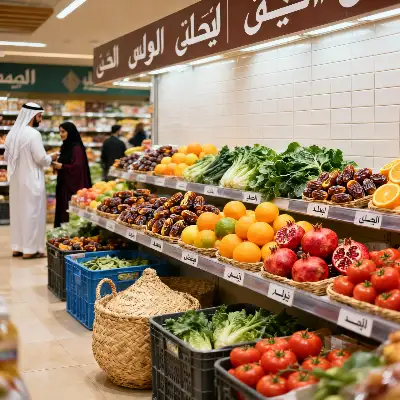
Saudi Arabia represents one of the largest vegetable consumption markets in the Middle East. While the country has invested in local agriculture, domestic production remains insufficient to meet national demand, particularly for fresh vegetables throughout the year. A large population, expanding retail chains, and a strong hospitality sector continue to drive import volumes.
Commonly imported vegetables include potatoes, onions, carrots, cabbage, tomatoes, and bell peppers. Exporters targeting Saudi Arabia must strictly comply with Saudi Food and Drug Authority regulations, ensure Arabic labeling, and maintain robust cold-chain logistics. Consistency in quality and documentation accuracy is essential for long-term success in this market.
Qatar: A Quality-Focused and Import-Dependent Market

Qatar vegetable import market
Qatar is one of the most import-dependent countries in the GCC, sourcing nearly all of its fresh vegetable requirements from international markets. Limited farmland and climatic constraints have made imports a necessity rather than a choice. High per-capita income and a preference for premium-quality produce define Qatar’s vegetable market.
Vegetables such as tomatoes, cucumbers, lettuce, onions, zucchini, and beans are consistently imported to meet retail and foodservice demand. Exporters who can deliver uniform quality, strong packaging, and reliable shipping schedules often establish long-term buyer relationships in Qatar.
Kuwait: A Stable Market with Predictable Import Demand
Kuwait vegetable imports
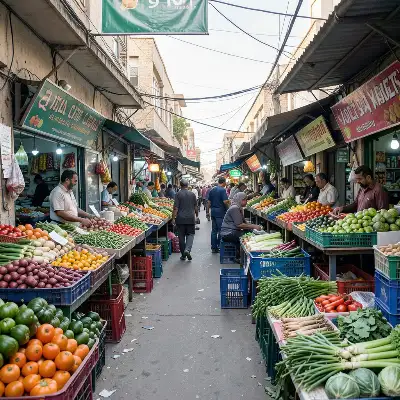
Kuwait relies heavily on vegetable imports due to minimal domestic agricultural output. The country maintains stable and predictable import volumes throughout the year, sourcing vegetables primarily from India, Iran, and European suppliers. Price competitiveness and freshness play a key role in purchasing decisions.
Onions, potatoes, tomatoes, eggplant, okra, and spinach are among the most frequently imported vegetables. Sea freight with temperature-controlled containers is the preferred logistics mode, and exporters must ensure precise documentation to avoid clearance delays at ports.
Oman: A Growing Import Market with Strategic Trade Location

Oman vegetable import market
Oman produces certain vegetables locally, but seasonal limitations and rising urban demand make imports essential. The country’s strategic geographic location also positions it as a redistribution point for regional trade. Imported vegetables such as onions, potatoes, tomatoes, cabbage, and green chilies are in consistent demand, especially during off-season periods.
For exporters, Oman offers opportunities as both a direct consumption market and a secondary gateway into other GCC regions.
Bahrain: A Small but Consistent Import Market
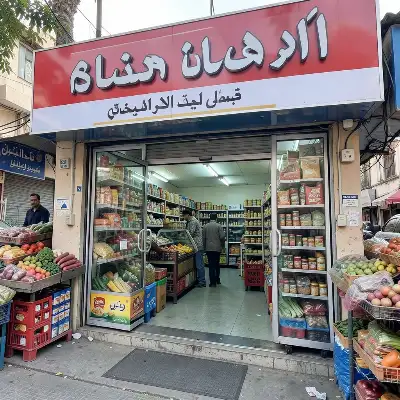
Bahrain vegetable imports
Bahrain is the smallest GCC market but remains heavily dependent on vegetable imports due to limited agricultural capacity. Imports are typically smaller in volume but more frequent, reflecting limited storage infrastructure. Vegetables such as onions, tomatoes, potatoes, and leafy greens dominate import demand.
Many exporters find it efficient to serve Bahrain through UAE-based distributors or regional wholesalers, making it a complementary market within a broader GCC export strategy.
Vegetables in High Demand Across GCC Countries
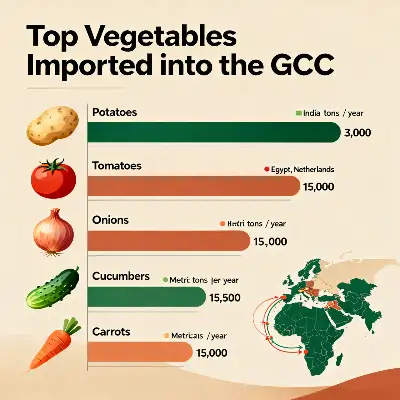
High-demand vegetables in GCC countries
Across all GCC countries, vegetables such as onions, potatoes, tomatoes, carrots, cabbage, okra, green chilies, and leafy greens show consistently high import demand. These products form the backbone of everyday consumption and are critical to food supply chains throughout the region.
Conclusion
The vegetable import market in GCC countries continues to expand due to strong consumer demand, limited domestic production, and sophisticated logistics infrastructure. By understanding country-wise market dynamics and aligning with a reliable logistics partner like GlobalShipify, exporters can access consistent growth opportunities across the UAE, Saudi Arabia, Qatar, Kuwait, Oman, and Bahrain. Strategic planning, quality assurance, and efficient logistics are the keys to long-term success in this high-potential region.